
“Just five more minutes!”
For a parent, that sounds like a small request. For a child halfway through Roblox, those five minutes might feel like the difference between finishing a challenge and abandoning it.
The timer goes off. You say it is time to stop. Your child insists they are almost done. Suddenly, a reasonable screen-time rule becomes an argument.
But what if the problem is not simply that your child refuses to listen? What if stopping is harder than our plan allows for?
Here is the distinction I find useful: A screen-time limit tells a child when to stop. A stopping plan helps them understand how to stop. You need both. Let us look at five roadblocks that can get in the way—and a small family experiment for handling them.
1. Your timer ends, but the game may not
Imagine watching a film and someone switches it off just before the final scene. You understand the rule, but you still want to know what happens.
A Roblox session can have the same mismatch. The clock counts minutes; the child may be counting attempts, checkpoints, rounds or things they are building. Some experiences have natural endings. Others keep offering something else to do.
These are two different clocks: the family clock (“30 minutes”) and the game clock (“one more checkpoint”). If we plan only for the first, we may catch a child halfway through the second.

This is not proof that any specific game is addictive, or that a child cannot regulate themselves. It is a practical way of noticing an unfinished transition. Child Mind Institute’s guidance on transitions recommends predictable routines, advance notice and cues to help children prepare for changes.
Try this: Before play starts, agree on a stopping opportunity that fits inside the time limit: the end of a short round, one last attempt, or a reasonable place to pause. If the game has no good stopping point, the time limit still wins. A checkpoint is a convenience, not an unlimited extension.
2. Sometimes your child is leaving friends, not just a game
“It is only a game” may sound perfectly sensible from the sofa. But what might the child be leaving?
Perhaps they are playing with friends, building something together, or waiting for a teammate. For them, stopping can also mean stepping away from a social moment.

Of course, this is not true of every Roblox experience. Some children play alone, and some care far more about a difficult obstacle course than about other players.
The better question is: what exactly is my child finding difficult to leave?
Ask at a calm moment: “What is the best part of Roblox for you—the challenge, the building, or playing with other people?” If a friend is involved, a short goodbye may help. If the child is focused on a challenge, a final attempt might be more meaningful.
Understanding what matters to your child does not mean allowing endless extra time. It lets you set a boundary that makes sense in the context of what they are doing.
3. “Five more minutes” can become a negotiation habit
Consider a familiar pattern. A parent says time is up. The child asks again. The parent refuses. The child protests. After a long day, the parent says, “Fine, five more minutes.”
The next day, the request arrives again.
That does not mean the child is deliberately trying to manipulate anyone. They may be genuinely disappointed. But children notice patterns: if asking repeatedly sometimes changes the rule, they have a reason to try again.
The screen-time limit has quietly become the opening offer in a negotiation.
Consistency does not mean becoming rigid about every second. Interruptions and genuine exceptions happen. The difference is whether you make a thoughtful exception beforehand or continually renegotiate during a protest.
Try this: Agree on the rule while everyone is calm. Explain reasonable exceptions in advance, and acknowledge disappointment without automatically changing the decision. A child can dislike the boundary and still be expected to follow it.
4. We have an ending time, but no landing routine
We plan when screen time starts. We plan how long it lasts. Yet sometimes our entire plan for what happens afterward is: “Put it away.”
That can feel like a sharp drop from something exciting into something undefined. A predictable next step may make the handoff easier.
As a software engineer, I think of this as a transition between states. Turning one system off is not the same as ensuring the next one is ready. Parenting is rather less predictable than software, but the handoff idea still helps.
A landing routine can be surprisingly ordinary:
- Preview the ending. Give a reminder that suits your child—perhaps five minutes before the limit.
- Close the current activity. Finish a short round or say goodbye when possible, without moving the agreed finish time.
- Move to what comes next. A snack, drawing, a book, outdoor play or another familiar part of the day.
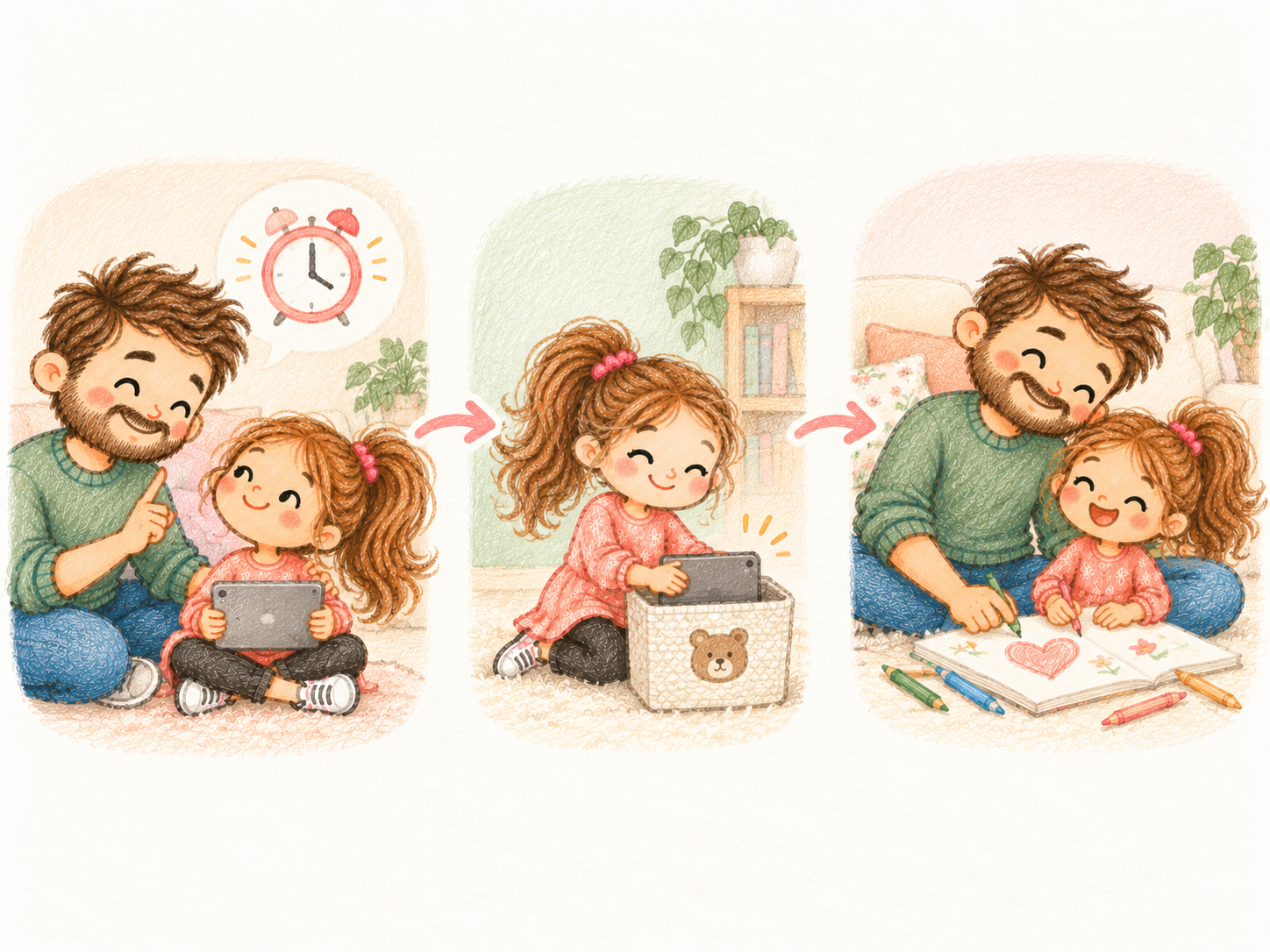
The next activity does not have to be an exciting prize. You do not need to become a one-person amusement park every time Roblox closes.
The American Academy of Pediatrics’ family media plan emphasizes shared rules, making space for other activities and revisiting the plan as children grow. An exit routine is one way to turn that broad advice into a specific moment at home.
5. Parents are tired, too—and that changes the conversation
There is another person in the room who may struggle with the transition: the parent.

Maybe you have just finished work, dinner is waiting, and there are still ten things competing for your attention. The last thing you want is a negotiation about five minutes in an obstacle course.
When we are tired, it can be harder to stay calm or consistent. We might lecture, offer a bribe, threaten an outsized consequence or surrender the limit to make the argument stop.
In its guidance on screen-time tantrums, the American Academy of Pediatrics recommends staying calm, avoiding lectures in the middle of a meltdown, and holding clear boundaries.
My practical takeaway: write your response before the difficult moment, not during it.
You do not need a long speech. “I know you want to keep playing. It is hard to stop. Our time is up.” Sometimes a short, steady answer is kinder—and clearer—than a ten-minute debate.
The twist: even a good stopping point can become another trap
Suppose you agree to stop at the next checkpoint. Your child reaches it—and sees another level just ahead. Or their friends launch a new round.
Now what?
This is where “stop at a natural point” can fail if we treat it as the only rule. Some games do not provide tidy endings. Other activities cannot be saved or paused whenever we want.
The better model is two boundaries working together:
- Time boundary: How long is this session allowed to last?
- Exit plan: What reasonable action helps us finish within that time?
A useful stopping point should fit the agreed time, not indefinitely move it. Sometimes the child will need to leave something unfinished. Managing that disappointment is also part of learning to play responsibly.
Can Roblox parental controls do the stopping for you?
Roblox provides daily screen-time limits and insights into a child’s activity. Its official screen-time instructions explain that when the daily limit is reached, the child can no longer use Roblox for the rest of that day.
Parents can manage available controls through a linked parent account, or use supported Parent mode options on a child’s device; the available controls depend on the child’s age and configuration. See the current Roblox parental-controls overview for the exact steps.
That limit is a useful guardrail. But it cannot guarantee that the game ends at an emotionally convenient moment. The conversation about how to stop still matters.
For a different Roblox decision, I have also written about what changes when a child turns nine on Roblox.
Try one three-step reset before the next Roblox session
I would not introduce five new rules at once. Instead, try one small experiment on an ordinary day. Explain the plan before the tablet is in your child’s hands.
Step 1: Agree on the ending before play begins
Pick the total time and an optional finish point that can fit within it. Decide what will happen if a game runs longer than expected. If the answer is “we leave when the timer ends,” make that clear now.
Step 2: Give a warning and connect with what they are doing
Move close enough to get your child’s attention. Give a brief reminder. If it helps, say what you notice: “You are nearly through that challenge. We have five minutes left.”
This does not promise extra time. It shows that you have noticed what they care about.
Step 3: Hold the boundary and make the next step clear
When the time ends, stay calm and make the next step predictable: “Roblox time is finished. Would you like to read together or help make a snack?”
A small choice can offer some control without turning the boundary itself into a choice.
A short script to try: “You can play until our timer ends. If you finish that round first, we’ll stop there. I’ll remind you before the time is up. Then we’ll put the tablet away and choose what’s next.”
What if your child still gets upset?
A good plan will not prevent every difficult moment. A child may be tired, hungry, stressed or simply disappointed. Some children need more support with transitions than others.
If your child protests, avoid trying to win a debate while they are overwhelmed. Keep everyone safe, acknowledge the feeling, use few words and return to the conversation when things are calmer. Later, ask one practical question: “Which part of stopping felt hardest?”
Difficulty stopping does not automatically mean addiction. But if intense reactions happen nearly every time, or gaming is affecting sleep, relationships, school or daily functioning, consider discussing the pattern with your pediatrician. The AAP describes signs worth raising with a clinician.
For a broader look at feelings and limits, see Your Child Is Overreacting. Or Are We Missing Something?
Next time, plan the landing—not just the timer
The next time your child asks for “just five more minutes,” you may still need to say no. But the conversation can be different if you planned the ending before the game began.
A timer tells a child when to stop. A thoughtful exit plan gives them a way to practise how to stop.

Before the next session, ask your child just one question: “What is a reasonable way for us to finish playing when time is up?”
Agree on an answer that respects the clock. Try it. Adjust what does not work. The goal is not a perfect evening or a child who never complains. It is a child gradually learning how to enjoy something they love—and still put it down.


Leave a Reply