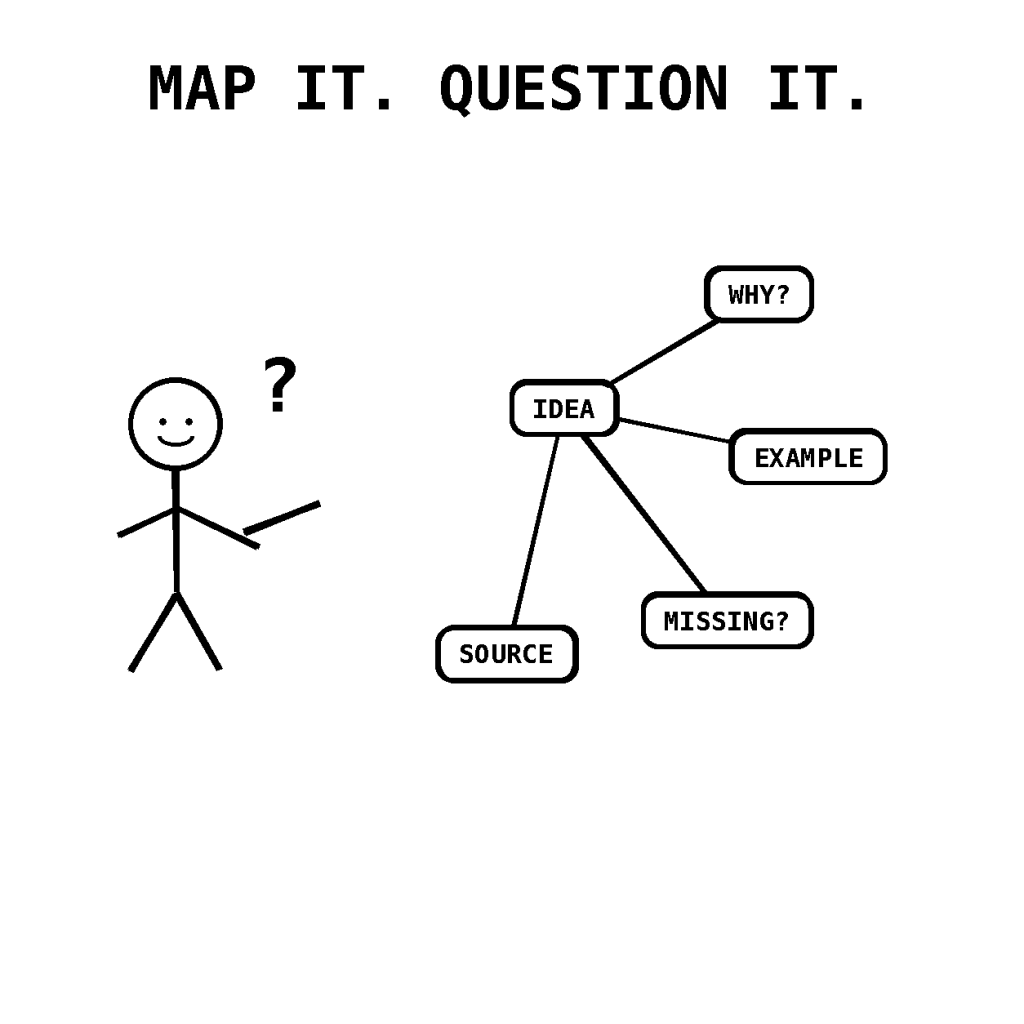
An AI tool can turn a lesson into a beautiful mind map in seconds. Planets have tidy branches. The water cycle has neat arrows. Every idea seems to have found its proper place.
It’s tempting to look at the finished picture and think, “Great, understood.” But the map belongs to the tool until your child has had a chance to question it.
A neat diagram is a starting point, not the learning itself
A mind map can help organise ideas, especially when a topic contains several related parts. Yet a well-arranged diagram can also make something unfamiliar look familiar. Recognising a label isn’t the same as explaining why two ideas connect.
Take the water cycle. A map could show evaporation, condensation and precipitation in the right order. Could your child explain what the Sun is doing? Could they say what might happen if the air cools? Those are different questions from reading the labels aloud.
Try drawing a rough map before asking AI for a polished one
Here’s a simple parent-led activity for a topic your child has already encountered at school or in a book.
- Predict: On paper, draw three or four ideas your child remembers. Arrows are welcome; artistic talent is not required.
- Compare: Look at a reference diagram or an AI-generated map together. Ask, “What’s missing from ours?” and “Is there anything here we disagree with?”
- Explain: Hide the polished version. Choose one connection from your child’s map and ask them to explain it in their own words.
- Check: Return to the original lesson, book or a reliable source for anything that remains uncertain.
That rough first sketch matters. It gives your child something of their own to compare with the generated answer, rather than asking them to admire an already completed diagram.
The most useful moment may be when the maps disagree
Suppose the AI map connects two concepts your child hadn’t linked. It might be a useful connection, a simplification, or a mistake. Ask what evidence supports it. AI-made diagrams can contain missing or incorrect relationships, so a polished shape should never get the final vote.
If a branch feels confusing, don’t immediately generate a bigger map. Revisit that section of the source together. You may find one missing explanation rather than a need for more information.
This works without giving a child their own AI account
Parents can lead the activity using a tool appropriate to their family and school rules, or simply use a textbook diagram. For younger children, adult supervision and privacy matter more than mastering prompts. UNESCO’s generative-AI education guidance also emphasises age-appropriate use, human agency and data protection.
A child who draws three imperfect arrows and explains them may have done more useful thinking than a child who merely receives twenty perfect branches. You can take that a step further with a simple explain-back check without AI.
So the next time a tool makes a lovely mind map, try this: hide it, ask your child to draw one connection from memory, then check it together. The picture should invite the thinking—not finish it.


Comments
One response to “An AI Mind Map Can Look Perfect. Can Your Child Explain It?”
[…] Why a polished AI mind map can hide weak understanding […]
LikeLike