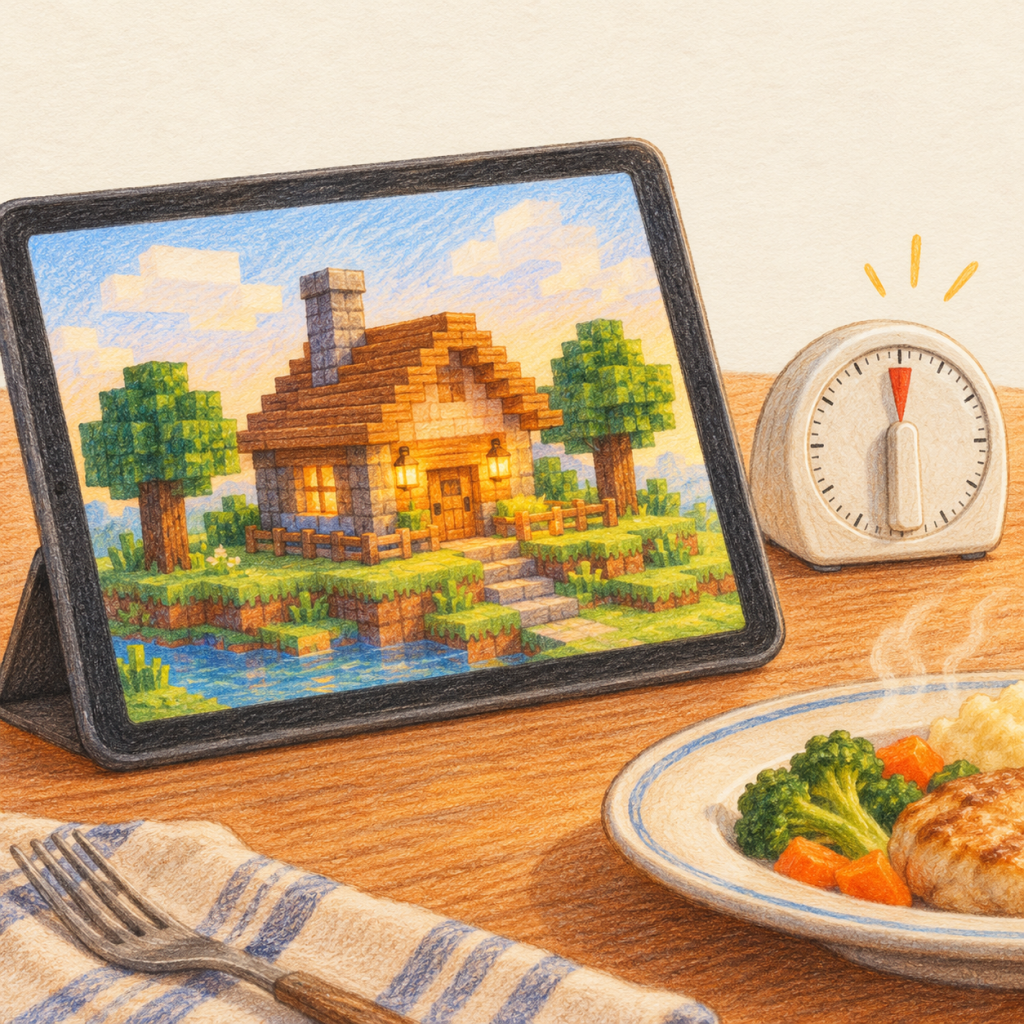
You said five more minutes. That was fifteen minutes ago.
Dinner is ready. Your child is still playing Minecraft. You are about to ask them to switch it off when they turn towards you.
“Wait. Come see what I made.”
You are tired of reminding them. You also do not want every screen-time conversation to end in an argument.
You can look at what they made without agreeing to more play time. Sometimes “Come see” is a way to share something they worked on. Sometimes it is an attempt to delay switching off. You know your child and the moment best. Either way, the limit can stay.
What might your child want you to see?
Imagine your child has spent forty minutes building a house in Minecraft. They chose the walls, moved the furniture around and spent a long time getting the swimming pool just right.
To you, it may look like another game. To them, it may be something they planned and made. Now they want you to see it.
Adults do this too. We ask someone to taste a meal we cooked or look at something we made. Children may want to share a digital creation for the same simple reason: they put effort into it and care what someone close to them thinks.
That does not mean every “Come see” is a request for connection. Sometimes your child really is trying to stretch the session. But it can help to notice what they want you to look at before deciding what to say.
A useful question might be, “What do you like most about it?” You may learn that the game is less interesting to them than designing a house, figuring out a mechanism or choosing how it should look.
Not every interest needs to become a lesson or a future skill. You can just be curious about what they enjoy.
Curiosity can feel different from a test
Parents have good reasons to ask how long a child has been playing, what they are watching and whether a game is suitable. We also want screen time to be worthwhile.
But if a child shows you something and the first questions are “What did you learn?” or “How is this helping you?”, the moment can start to feel like a test.
Sometimes a simpler response is enough: “That looks fun. How did you make it?” Then let your child show you the part they chose. They can be the one who knows how the game works for a minute.
The American Academy of Pediatrics encourages parents to sometimes watch, explore or play alongside their children. Shared media can help parents understand a child’s interests and create openings for conversation. It does not mean you need to supervise every minute or ask them to explain everything they do.
There is a difference between joining because you are interested and joining only to check whether the activity is useful. Children may notice which one you are doing.
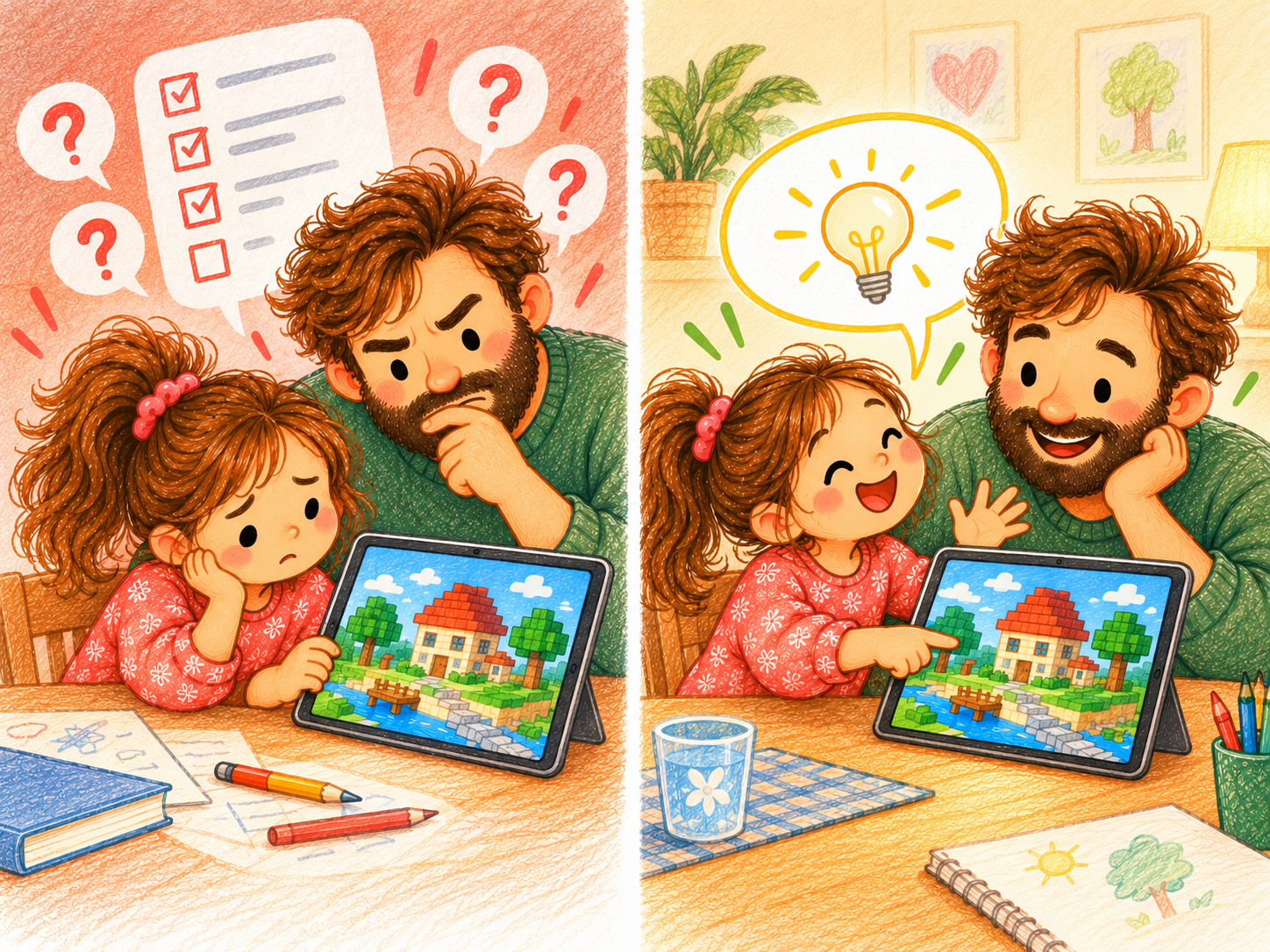
Dinner is getting cold. You can still keep the limit.
This is where co-playing meets an ordinary evening. You have things to do, screen time has gone past the agreed limit, and you do not want “Come see” to turn into another twenty minutes.
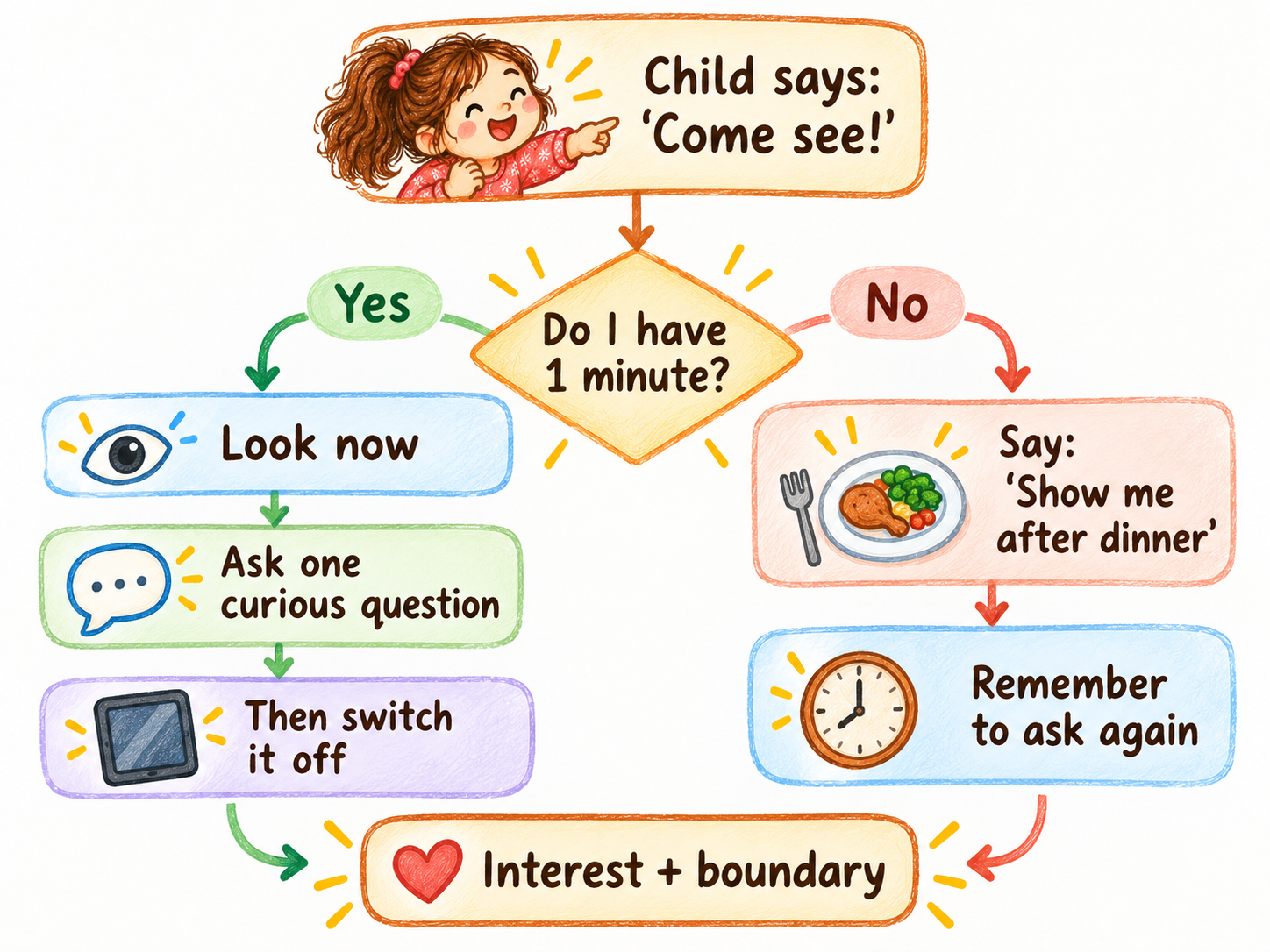
If you have a minute, try: “Show me your favourite part, then we’re switching it off.” You can give their creation your attention and still follow through on the limit.
If you really cannot stop, say: “I want to see it, but dinner’s ready. Can you show me after we eat?” Only offer a later time if you can follow through. If the game does not let your child save their progress, plan for that before the next session instead of extending play automatically.
Your child may still be upset when the game ends. That does not mean you have to remove the boundary or that you handled the moment badly. The aim is not to make every limit pleasant. It is to keep interest and limits in the same conversation.
Try this the next time they call you over
First decide whether you can give them a minute now. If you can, ask them to show you their favourite part, then end the session at the time you agreed.
If you cannot stop, name when you can look and remember to ask again. Later, a simple “Did you finish that house?” may be enough. Your child might tell you the whole story, or they might shrug. Both are fine.
Later, you might ask, “Did you finish that pool?”


Leave a Reply